
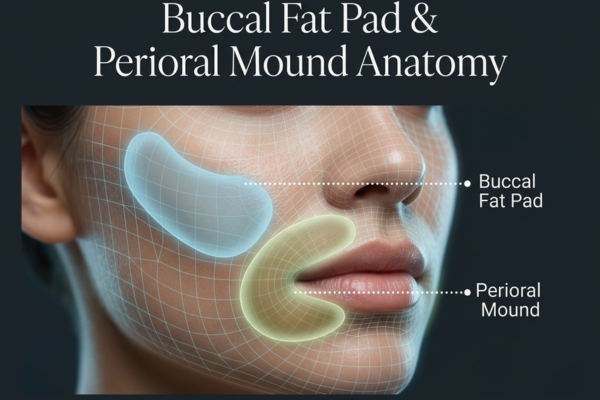
Few areas in facial aesthetics generate more confusion, and more avoidable surgical mistakes, than the lower face. Specifically: the fullness that can form around the corners of the mouth, below the lips, and along the lower cheeks as we age.
Patients come in describing it in different ways. Some call it “chipmunk cheeks.” Others say their face looks heavy or jowly around the mouth. Some have been told they need buccal fat removal. Some have already had it done and are now worse off than before.
The problem, almost always, is that two anatomically distinct structures are being confused for one another: the buccal fat pad and the perioral mounds. Treating one when the problem is the other doesn’t just fail to help. It can cause lasting damage that’s harder to correct than the original concern.
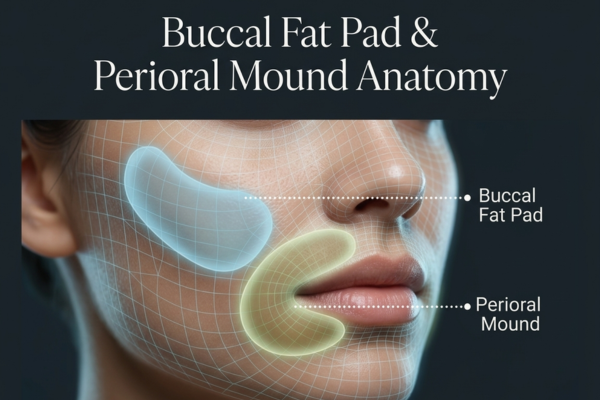
What Are Perioral Mounds?
Perioral mounds are an entirely different structure. They sit more superficially, closer to the skin surface, and are located at the corners of the mouth, between the end of the nasolabial fold and the lower cheek. They don’t have the defined capsule of the buccal fat pad. The fat here is thinner, less discrete, and overlies the SMAS layer (the same deep facial tissue layer addressed in facelift surgery).
Perioral mounds are caused by a combination of factors: bone resorption in the jaw over time, descent of superficial fat pads from above, and the constant mechanical force of the muscles surrounding the mouth, particularly the orbicularis oris. They tend to become more visible with age and are sometimes described as “mouth pouches” or the fullness that sits just below and to the sides of the lips.
Perioral mounds sit between the lower edge of the cheek fat compartments and the fat compartments that form the jowls, and they can become fuller and droopier with age. They are frequently confused with both jowls and buccal fat.
For a deeper read: Gu Y et al. Efficacy and Safety of Perioral Mound Region Liposuction. Aesthetic Surgery Journal, 2023. (PubMed)
